When I was little I dreamed of reaching the year 2000, because it was the year I would turn 20, and throughout my whole adolescence my friends and I fantasized about what we would do at 20; what we would study, would we already have our first boyfriend?. :P
The problem is that, since I've always been a bit short-sighted, I never thought about reaching 2020. My God, 2020! It really wasn't in my plans... and now, well, luckily I've made it this far, and since you're all very clever you'll have already deduced that... instead of 20 years, this year I turn 40! I'm supposed to already be an adult, mature and, above all, to have the goals of my life clear... well, let's start with the easiest thing and what you've asked me for by popular acclaim: My challenges for this 2020. :)
Challenge number 1: Be braver.
Can you imagine if, when the ball reached Messi, he started analyzing the chances he has of scoring it or making a good pass? Well no, Messi shoots, shoots, shoots and shoots again, he always asks for the ball, Messi makes mistakes, few, but he makes them... he is probably the best player in the world, but Messi is brave, very brave, and he takes the risk; whenever he can he asks for the ball and shoots. Do you think he doesn't suffer? Those thousandths of a second while the ball flies feel eternal to him, he doesn't know whether it will end up with the opposing team or go into the goal.
Messi is brave and he shoots, he's not afraid of his status, he's not afraid of making a mistake nor of what people will think if it doesn't go in. You have to ask for the ball, you have to want to play it, you have to be brave and shoot every time you can. He's the best because he's worked for it, but if he weren't brave in matches he wouldn't be Messi.

Messi is an extreme example, obviously, but if you think about it carefully something very similar happens to all of us. There's a logical pairing that my marketing professor, Carles Torrecilla, taught me on the first day of class: the risk-return pairing; the greater the risk the greater the return, and vice versa. There are risky projects, but if you win, you win big, not only financially but also in terms of learning. And what if I lose? Well, that's what you take away, that's what you've learned. In the United States a professional who hasn't failed at some point isn't considered seriously, because it's understood that they don't have courage, that they don't have one of the characteristics most sought after by companies; entrepreneurship, or in other words, what in Spanish we call "emprendeduría", which sounds less guay (cool) but is the same thing: the bravery to lead and carry out a project of one's own free will.
We women, by genetic nature, tend to be more analytical, and careful, because what can happen to us is that we lose tremendous opportunities, both personal and professional, because of falling into "paralysis by analysis...".
Success, as defined by Marc Correa, professor and vice dean of the Executive Education programs at ESADE Business School, is explained in the following graph;
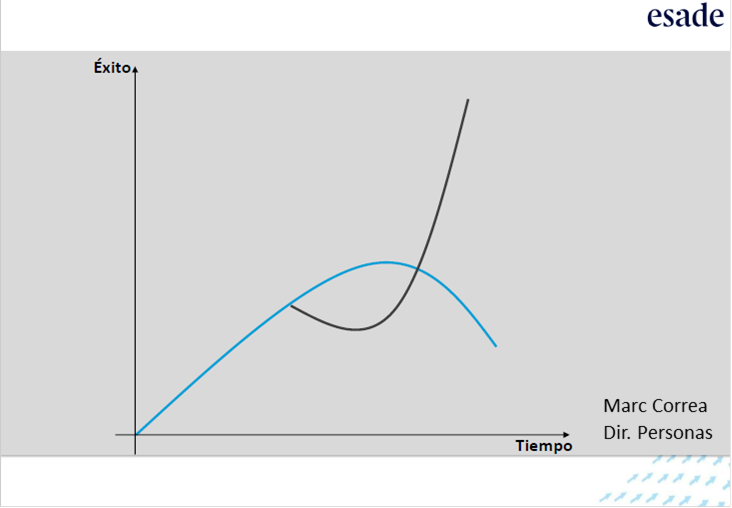
Success is defined by the ability we have to change projects over time, and that implies leaving our comfort zone, or in other words: being brave.... Marc tells us that you have to change when you're doing well, when the blue curve is still rising, when we're at our best moment, the one in which you start allowing yourself the odd free afternoon to go play paddle tennis because you've got everything under control... well no, error! That's precisely when you have to take the risk, you have to leave your comfort zone and jump to the next step. Does it have risks? Yes, loads.... if you jump too soon, oops, there was no line, you've been hasty, you fool! And if you jump when you're already in obsolescence, well, you've messed up too... but for sure, whatever happens, you learn from the process. Success is taking the risk, being brave and jumping!.
Note 1: being brave is not being reckless... to be brave you have to know the risks and assume them; being reckless is acting like an idiot... it's not about jumping into the void, it's about assuming known risks.
Challenge number 2: Learn to say no assertively.
Let's start with the easiest thing, what is assertiveness?
Assertiveness is a social and communicative skill that consists of knowing one's own rights and defending them, while respecting others;
wikipedia.
Well, I often lack assertiveness, the first step is to acknowledge it :). Since we don't yet have the gift of ubiquity and our energy is not infinite, many times we have to say "no, I'm sorry, I can't...". We all receive many requests for collaboration, invitations and proposals of all kinds, and obviously you can't say yes to all of them. Here you do have to dedicate some time to analysis; at the very least make a list of PROS and CONS. If it's a professional proposal, careful, don't get hung up on profitability; sometimes the benefit doesn't have to be purely economic, not all transactions have to be commercial. Sometimes they bring other things, like personal positioning, or you're doing a favor for someone you appreciate, or you simply feel like participating and that's that.
But... oh my friend, what about when it's time to say NO?!. It absolutely kills me and I always have the feeling I'm doing it wrong... there are two scenarios here;
- My children. Some children have a tendency to ask, ask, ask and keep asking; I have one of those... it's Luisito, he's very funny and creative but he wears out the patience of a saint. He's also hyperactive (diagnosed), so day in and day out, my answer is usually "Luisito, no, because I say so and that's final...". I could explain it to him a bit more, or negotiate, or maybe even make him a plan of objectives with rewards, but I don't do it, because by the time I get to see him my patience, my self-control, is already exhausted; I've used it up during my working hours. Self-control has a limit, so you have to find strategies so that it isn't always the same ones who receive the NO in a bad way, since that's what Luisito will learn and replicate in his life, and I don't want that...
- Professional relationships, there are many scenarios here; requests from the team, from a client, from your bosses... it's hard to say no to that last one :), but for example sometimes it happens that if you work very independently, suddenly they ask you for something on a date you're not available, and you can mess things up if you don't know how to answer well... there's nothing more cowardly and unprofessional than not facing things head-on.
My strategy for improving my assertiveness; time and methodology.
1.- Time: we have the bad habit of expecting an immediate response, and not only is it not necessary but sometimes it's counterproductive. Nobody is asking you for it, the email isn't going to disappear from your inbox, and if it was a call, well, you thank them for the proposal and for thinking of you, but tell them you have to look into it and you'll get back to them; ask if there's a deadline and that's that. The bad part is the whatsApps or social media; supposedly if you're connected you have to answer immediately, well no... When you've thought about it, slept on it, in my case I think about it while I go running, that's when my ideas become clear (almost always...). When you've got it clear and you're sure, you answer politely. Time will be your best advisor.
2.- Methodology: establish rules. If there are requests that recur, put things in order, that is, prepare a response that you can more or less adapt, and an approval document for requests, and set a weekly or monthly date to approve requests. The bigger your team is the more proposals there will be, and that's certainly good, but if you don't put order and methodology in place you can go crazy. In my case the approvals will be done on Mondays and with a minimum of one month's notice. In the case of external professional collaborations, you can prepare a document with the conditions, so that when they go to ask you for something you've already internalized what the rules are, in a good way, because everyone's time is limited and, as with everything in life, you have to know how to choose and prioritize.

Challenge number 3: Read more and note down what I like.
I've never been a great reader, but I do read everything that falls into my hands; it may sound strange but let me explain.... I'm a diagonal reader, that has risks and benefits; if you're having a good day you catch the ideas on the fly and can apply them quickly, but if you're juggling a thousand things you don't take anything in and you've wasted your time and money...
There are books that hook you more than others, but they all contribute something. There are also websites and blogs that keep you updated on the topics that interest you most. I always say it and it's my motto: "never stop learning". It's blindingly obvious, but we're lazy and we're tired when we get home... look at what the statistics say:
In Spain we spend 5 hours and 18 minutes a day connected to the Internet through any device. We dedicate 1 hour and 39 minutes to social media, while we spend almost 3 hours in front of the TV, whether traditional, streaming or on demand. Music is what takes up the least time, since we only dedicate 42 minutes a day to listening to it via streaming.
Data from Hootsuite, the most widely used social media management platform,
and We Are Social
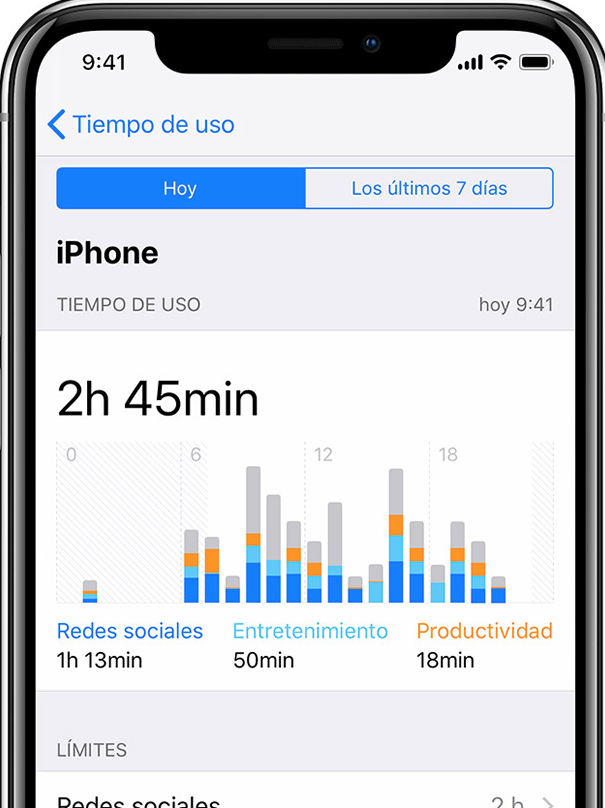
and you'll think "no way, not me, not that much..." Not that much? I challenge you to look at your phone's usage time; in the case of the iPhone it details exactly how much time you dedicate to each activity, you can even set a "usage limit".
My strategy for challenge 3:
Steal time from time, that is, that 1:30h that I dedicate to social media: let's say I need 30 minutes a day at minimum for my work, but what about the rest? The rest is pure gossip, folks...
Being realistic, I see myself capable of setting a limit of 1 hour a day on social media, and the other 30 min are more than enough for me to do the following:
- Read 1 article a day from Harvard Business Review (the subscription is €14 a month and you have articles on everything, and it's in English to boot!)
- Read one of the books I have half-finished:
- Watch a TED talk; on leadership, on beauty, on management... there are plenty to go around.
- Carry a notebook, or even on your phone you have a virtual "notepad" where you can jot down whatever catches your attention most.
- Business ideas that occur to you and seem impossible; research them, read... etc
My first "TO DO" in this challenge will be to read "Good Night Stories for Rebel Girls" . I hope I'm lucky and that my dear King Balthazar leaves it under the tree for me tonight.;P

Last but not least... my final challenge for this 2020:
Keep being authentic.
As Agrado says in Almodóvar's film All About My Mother : "It costs a lot to be authentic, ma'am, and in these matters one mustn't be stingy, because you are more authentic the more you resemble what you have dreamed of being".
I wish you the best possible 2020 and keep chasing your dreams, with lots of determination and joy. :)
Leave us your comment!
Woman&Business.
Cargando comentarios...